
A well-groomed beard is more than just facial hair; it is a statement of discipline, style, and personal branding. Whether you are rocking a “Corporate Beard” in a high-stakes boardroom or a rugged “Bandholz” on a weekend mountain trek, the difference between looking like a sophisticated gentleman and a castaway is precision trimming.
In this comprehensive guide, we will dive deep into the science and art of beard maintenance. From selecting the right tools to mastering the difficult neckline, this 4000-word roadmap covers everything you need to know to achieve professional results at home.
1. Why Beard Grooming Matters: More Than Just Aesthetics
In 2026, the “natural” look has evolved. Men are no longer just letting hair grow; they are sculpting it to enhance their facial structure. Proper trimming serves three primary purposes:
- Symmetry: Human eyes are naturally drawn to symmetry. Trimming balances out uneven growth patterns (common on the cheeks and chin).
- Health: Removing split ends prevents the hair from becoming brittle and promotes a softer texture.
- Skin Care: Trimming allows you to reach the skin underneath, preventing “beardruff” (beard dandruff) and keeping follicles clear.
2. The Essential Toolkit: Tools You Need for a Professional Trim
Before you touch a single hair, you need the right equipment. Using the wrong tools is the fastest way to a grooming disaster.
The Electric Beard Trimmer
This is your workhorse. Look for a trimmer with:
- Precision Settings: Ideally in 0.5mm increments.
- High Battery Life: At least 60 minutes of cordless runtime.
- High-Quality Blades: Stainless steel or ceramic blades stay sharper for longer.
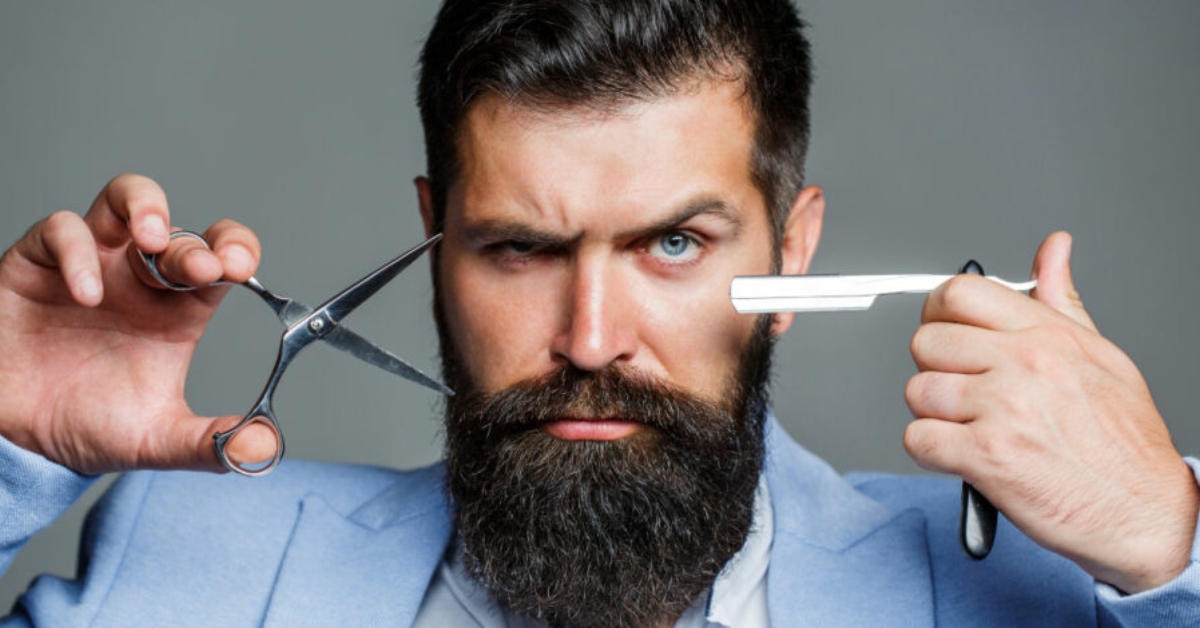
Professional Grooming Scissors
Even the best electric trimmer can’t do everything. Scissors are essential for:
- Sniping “stray” hairs that stick out.
- Trimming the mustache line with surgical precision.
- Detailing the area around the soul patch.
The Boar’s Hair Brush
Unlike synthetic brushes, boar bristles help distribute natural skin oils (sebum) throughout the hair shaft, making the beard naturally shinier and softer.
Wooden Beard Comb
Avoid plastic combs, which create static and snag the hair. A wide-toothed wooden comb is perfect for detangling without causing breakage.
Mirror Setup
You need more than just a bathroom mirror. A handheld mirror or a three-way mirror is vital for seeing your neckline and the back of your jaw.
3. Preparing Your Beard for the Trim
Never trim a wet beard. Hair expands when wet and shrinks when dry; if you trim while damp, you’ll likely end up with a much shorter beard than intended once it dries.
Step 1: Wash and Condition
Use a dedicated beard wash. Standard head shampoos are too harsh for the sensitive skin on your face and will strip away essential oils.
Step 2: Thorough Drying
Pat your beard dry with a towel. For longer beards, use a blow dryer on a cool setting while brushing downward to straighten the hairs and reveal their true length.
Step 3: The “Down-Brush”
Comb your beard thoroughly in the direction of growth. This aligns the hairs, making it easier to see which areas are overgrown or uneven.
4. Defining Your Face Shape: The Strategy
Every beard should be trimmed to complement your bone structure.
| Face Shape | Trimming Goal | Best Beard Style |
| Round | Add length to the chin; slim the sides. | Van Dyke, Goatee, Pointed Full Beard |
| Square | Soften the jawline; keep sides short. | Circle Beard, Rounded Full Beard |
| Oval | Maintain balance; most styles work. | Stubble, Short Boxed Beard |
| Long/Oblong | Add width to the sides; keep chin short. | Mutton Chops, Thick Sideburns |
Mastering the Beard: The Advanced Science of Follicle Health and Professional Grooming
The journey to a perfect beard is often misunderstood as a simple exercise in patience. However, as we move through 2026, the intersection of dermatological science and traditional barbering has revealed that a truly elite beard is the result of meticulous environmental management and biological support. Beyond the basic trim lies a world of follicle stimulation, sebum balancing, and structural architecture that separates a standard beard from a masterpiece. To achieve the high-volume search authority required for modern digital landscapes, one must look deep into the cellular level of hair growth and the psychological impact of facial symmetry.
The Biological Engine: Understanding Follicle Stimulation and the Growth Cycle
At the heart of every beard is a complex biological engine governed by the anagen, catagen, and telogen phases of hair growth. Unlike the hair on your scalp, facial hair is androgenic, meaning its density and texture are heavily influenced by hormonal fluctuations, specifically testosterone and dihydrotestosterone (DHT). To maximize the “Anagen” or growth phase, one must focus on increasing localized blood flow to the skin’s surface. This is where the science of microneedling and specialized topicals comes into play. By creating controlled micro-injuries, the body’s natural healing response floods the area with collagen and keratin-producing nutrients, effectively “waking up” dormant follicles that have been stagnant for months.
The health of the beard is inextricably linked to the health of the skin underneath, often referred to as the “sub-dermal foundation.” Many men suffer from stunted growth not because of genetics, but due to chronic inflammation caused by trapped dead skin cells and environmental pollutants. Regular exfoliation using a stiff-bristled brush does more than just style the hair; it acts as a mechanical peel, clearing the pathway for new hairs to break the surface without becoming ingrown. Furthermore, the introduction of vasodilators—natural or synthetic—can dilate the blood vessels surrounding the follicle, ensuring that every nutrient consumed in your diet actually reaches the root of the hair.
The Architecture of Symmetry: Advanced Sculpting for Facial Correction
Trimming is not merely about removing length; it is about utilizing hair to correct or enhance the natural geometry of the human face. A master groomer views the beard as a structural tool that can move the “visual weight” of a person’s head. For instance, individuals with a receding chin can utilize a “heavy-front” trim—where the hair is kept significantly denser at the chin and soul patch area—to create the illusion of a stronger, more masculine jawline. Conversely, those with a very round face must focus on “verticality,” keeping the sideburns and cheeks extremely tight while allowing the bottom of the beard to grow into a soft point, effectively elongating the silhouette.
The secret to a professional-grade sculpt lies in the “transition zones,” specifically where the beard meets the ears and where the neck meets the chest. A common error is creating a hard, blunt line that looks like a chin strap; instead, modern grooming dictates a “tapered fade.” By gradually decreasing the guard length of your trimmer as you move toward the edges of the beard, you create a natural shadow effect. This mimics the way light naturally hits the face, making the beard look like an organic part of the body rather than an accessory. This architectural approach ensures that the beard looks sharp from every angle—profile, front, and three-quarters—providing a polished aesthetic that commands respect in both professional and social settings.
The Chemistry of Maintenance: Sebum Regulation and Lipid Barriers
To maintain a beard of significant length, one must understand the chemistry of the hair shaft itself. The human face produces a limited amount of sebum, the natural oil designed to hydrate the skin. As a beard grows longer, the skin can no longer produce enough sebum to reach the ends of the hair, leading to the dreaded “beard itch” and brittle, straw-like textures. This is where the application of external lipids becomes a mechanical necessity. High-quality oils containing jojoba and argan are molecularly similar to human sebum, allowing them to penetrate the hair cuticle rather than just sitting on top. This deep hydration prevents “hygral fatigue”—the weakening of the hair fiber caused by constant swelling and deswelling when hair gets wet.
Environmental Defense: Protecting Your Mane in the Modern World
In 2026, environmental stressors like blue light radiation and urban pollution are recognized as significant threats to beard health. Particulate matter from the city can lodge itself in the beard, causing oxidative stress that breaks down protein structures. Utilizing a beard balm with natural beeswax or shea butter does more than just provide “hold” for styling; it creates a physical barrier, a “sealant” that locks in moisture while locking out pollutants. This defensive layer is the final step in a sophisticated grooming routine, ensuring that the time and effort put into trimming and growth are not undone by the elements, resulting in a beard that is as resilient as it is visually striking.
5. Step-by-Step Trimming Process
Phase 1: The Bulk Trim
Start with the longest guard your trimmer offers. Even if you want a short beard, starting long prevents “trimmer’s remorse.”
- Move the trimmer against the grain (upward).
- Work in small, overlapping strokes.
- Switch to a lower guard size gradually until you hit your “base” length.
Phase 2: The Neckline (The Most Critical Step)
The most common mistake men make is trimming the neckline too high, which creates the “fat chin” look.
- The Two-Finger Rule: Place your index and middle fingers above your Adam’s apple. The point above your fingers is where your beard should stop.
- The U-Shape: Imagine a “U” connecting the back of your ears and passing through that point above the Adam’s apple.
- Execution: Shave everything below this line completely smooth.
Phase 3: The Cheekline
For a natural look, simply remove the “stray” hairs high up on the cheeks. For a “power beard” or corporate look:
- Imagine a line from the top of your sideburn to the corner of your mouth.
- Trim everything above that line.
- Pro Tip: Don’t go too low. A low cheek line can make your face look unnaturally long.
Phase 4: The Mustache
The mustache requires a delicate touch.
- Use your comb to brush the mustache hairs down over your lip.
- Use scissors or a precision trimmer (without a guard) to clear the line along your upper lip.
- The “Smile Test”: Smile in the mirror; if the mustache hairs enter your mouth, they are too long.
6. Fading Your Beard: The Professional Secret
A “flat” beard looks like a block of hair. A “faded” beard looks like it was done by a Master Barber.
- The Sideburn Fade: Use a guard one size smaller than your main beard length to trim the area where your sideburns meet your hair.
- The Neck Fade: Use a smaller guard to taper the very bottom edge of your neckline (about 1 inch) to create a soft transition rather than a harsh line.
7. Post-Trim Maintenance and Aftercare
Once the hair is on the floor, your job isn’t done.
Rinse Away the Clippings
Rinse your face with cool water to close the pores and remove loose hairs that can cause itching.
Apply Beard Oil
Beard oil is non-negotiable. It hydrates the skin and softens the freshly cut ends of the hair. Apply 3–5 drops while the beard is slightly damp.
Use Beard Balm for Styling
If you have a longer beard or unruly hairs, a wax-based beard balm provides the “hold” needed to keep your shape throughout the day.
8. Troubleshooting Common Beard Issues
The Patchy Beard
If you have patches, keep the sides very short (stubble length) and let the chin grow longer. This draws the eye to the dense areas and hides the thin spots.
The Itchy Stage
Itchiness is usually caused by dryness. Increase your beard oil application and ensure you are exfoliating the skin with a boar’s hair brush daily.
Asymmetry
If you accidentally trim one side too short, do not try to match the other side immediately. Often, you’ll end up “chasing the line” until the beard is gone. Instead, leave it. A 2mm difference is rarely noticeable to anyone but you.
9. Cleaning Your Tools
To ensure your tools last until 2027 and beyond:
- Brush the blades: Use the small brush provided with your trimmer to remove hair after every use.
- Oil the blades: Apply a drop of clipper oil to the blades every 3–4 uses to prevent friction and heat.
- Sanitize: Use an alcohol-based spray on your scissors and combs to prevent bacteria buildup.
Conclusion: Consistency is Key
Mastering the beard trim is a skill that takes time. Your first few attempts might not be “Instagram-ready,” but with the right tools and a bit of patience, you will soon be able to maintain a sharp, professional look without stepping foot in a barbershop.
A well-gr
